OPEN FERMENTATION [home] [topic page]
When picked, the bunches of grapes are placed in large fibreglass or stainless steel tanks which are open to the air.
If a white wine is to be produced, then the juices are extracted by pressing before fermentation, otherwise for red wines, all are placed in together. It is the skins of the grapes that give a wine its colour.
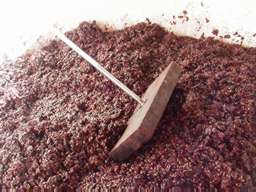
Pinot noir grapes under open fermentation. Courtesy N Butler Holm Oak
Yeast ( Saccharomyces cerevisiae ) is added. This is at a concentration
of around 2~500 ppm.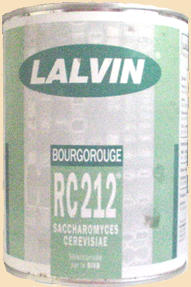
This small single celled fungus replicates quickly living on the sugars of the grapes and converting them to ethanol and CO2. The higher the sugar level of the grape, the higher the subsequent alcohol level. This has strong implications on the future of the wine both in longevity in the bottle and future maturation. The higher the alcohol level, the greater the future.
Conditions for yeast growth are important. The best temperature for the tanks is around 300C though, as the reactions are exothermic, 350C may be reached.
Other conditions must be met at this point.
Potassium metabisulfite ( K2S2O5 ) is added for the production of SO2 within the fermenting wine to act as an antioxidant of the alcohol. Ascobic acid ( vitamin C ) will also have this affect. ( Oxidizing alcohol will react to acetic acid.)
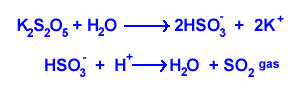
The grape's molecules often contain sulfur as part of their structures. In fermenting, it is possible for H2S ( "rotten egg gas" ) to be produced which would be disastrous. It turns out that it is the reactions within the yeasts that lead to H2S depend on nitrogen balance in the juices. Should the balance be incorrect, diammonium phosphate ( NH4)2HPO4 is added.
Fermentation lasts for 7 to 10 days. The tanks are "plunged" regularly meaning that the fermenting mass is stirred by pushing the rising masses of reacting grapes back down through the fluids. This prevents the skins etc drying out and becoming bacterially contaminated.
