CLIMATE [home] [topic page]
Climate and soils are very important to the wine industry. The grape itself is a fruit which must ripen to make wines. The cooler the climate, the less time to ripen.
In Europe, the northern most limits of wine production include the Rhine Valley in Southern Germany. Here rich "Moselles" and other late picked wines are produced. Why late picked? To allow time for ripening to occur, these varieties are picked in late autumn.
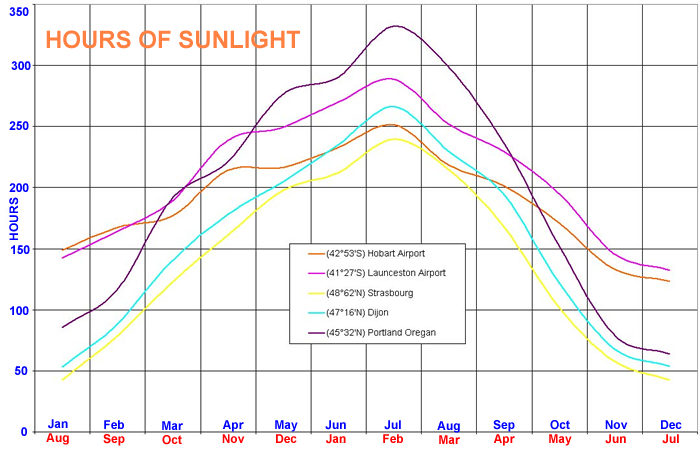
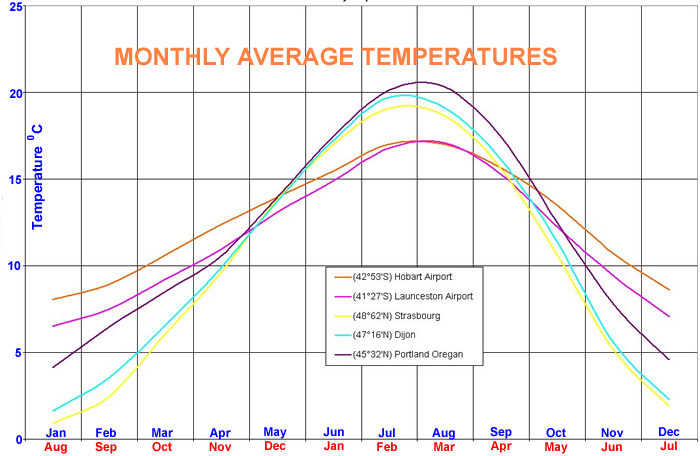
The Tasmanian climate resembles that of the Bordeaux region of France, a very famous wine making region. Tasmania's latitude is 420 South whereas Bordeaux is 450 North. The number of sunlight hours is very similar during the growing season and its temperature range is similar in summer.
Graphs are courtesy of Mr Duncan Farquhar of the Dept of Primary Industry of Tasmania
France has two broad wine regions, the South around the Mediterranean with a significantly warmer climate and the cooler North. Wine styles and varieties reflect this on the larger scale. Southern wines are very full bodied (robust) while northern wines are more elegant or subtle and reflect different varieties of grapes. Tasmania shows the same differences to the rest of Australia. Some of the greatest mainland varieties are based on the shiraz grape. Pinot grapes do not do particularly well in the Barossa Valley or Hunter Valley. In Tasmania, it is the converse with Pinot grapes producing excellent wines, shiraz grapes not doing particularly well.
Tasmanian wines are much more elegant than those of the mainland. They are of world standard but to a different taste than those of South Australia and New South Wales.
To maximise the sun, most vineyards are planted on northern or north-eastern facing slopes and use trellises to open the bunches to the sun. It is important to the development of the bunches that frost and wind do not kill or slow growth of the plant.
Grapes begin to grow when the temperature reaches above 100C. To reach maturity, a total amount of heat above this temperature is required. A measure of this quantity of heat is called the
HEAT SUMMATION = sum of number degrees of average temperature >100C for each day during the growing season.
Successful growth in Tasmania requires about 8000.
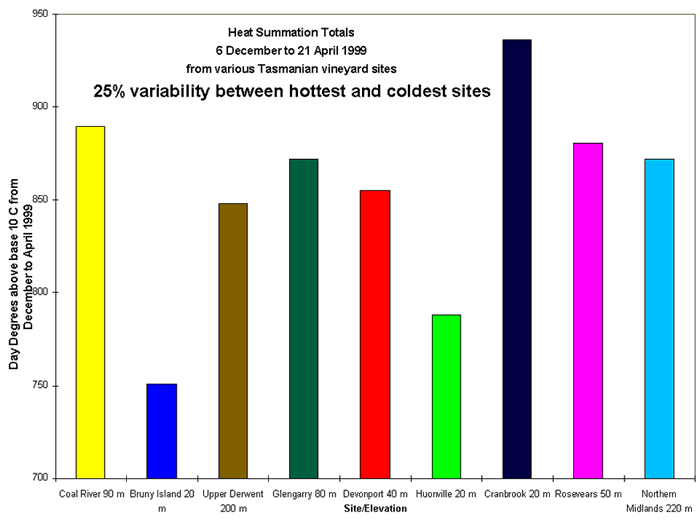
This is considerably lower than Barossa area which receives about 13000C during the growing season.
Less will not lead to successful ripening and acidity will be too high.
Conversely, too high heat summation leads to earlier maturation and less acidity and colour.
Clearly frosts, clouding, rain etc are highly significant factors in wine growing. Rain close to picking can lead to problems with bacterial rots or moisture content of the grape rising so lowering the sugar concentration.
Soil moisture levels are also a vital consideration with large vineyards using controlled irrigation techniques. Much depends also on local soil types.
Tasmania's School of Agricultural Science has its own vineyard and is actively involved in developing more advanced processes of monitoring nitrogen, water and other variables in the soils. One technique being investigated is asymmetrical irrigation in which one side only of the plant is irrigated.

