PRESSING AND BARRELING (Casking) [home] [topic page]
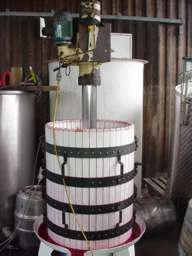
After fermentation has stopped, the fermented juices are separated from the stems and skins by placing the contents of the tank into a press which squeezes the juice out.
Wine press with fermented juices leaving base
Pressing ceases when the juice begins to taste of stem chemicals.
At this stage the pH is often measured to evaluate the malic acid content. The titration is carried out against tartaric acid in the fermented juices. pH should be about 3.3 to 3.4 for a pinot grape.
Titration at Holm Oak 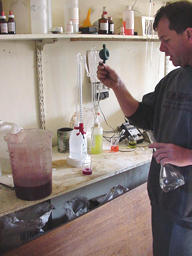
Malic acid is undesirable in red wines as it gives an extra acidity and "appley" taste, though it is sometimes left in white wines. To eliminate it, a second fermentation must be started in the barrel. Should this second fermentation take place in the bottle, undesirable tastes appear lowering the quality of the poured wine.
The juices are filtered to get rid of finer particulates then either it is placed in a tank or barreled.
The second fermentation to eliminate malic acid uses a second bacterium, Leuconostoc enos. The result is lactic acid and CO2.
These bacteria are inserted into the barrel with the juices and held for 1 year to 18 months.
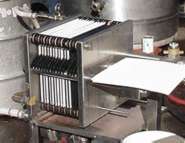
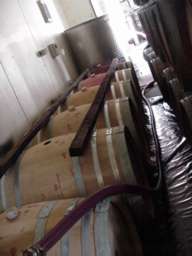
wine filter
If very fine particles are still present in the wine, "finings" may be added to force them to settle out. Finings may be egg whites or powdered clay ( bentonite ) or gelatine. These are then removed.
In grapes, the basic acids are those of most fruits, tartaric, malic and citric acids, however the citric acid percentage is very low and can be ignored.
Malic acid is largely present from stems or unripe fruit so tartaric acid is the prime constituent of the fruit itself. Malic acid's presence may not be welcome in some wine types so it is often eliminated in a controlled fashion rather than uncontrolled as was once the case in traditional methods. It is a "fragile" molecule so its reduction to lactic acid is better done under controlled conditions in the barrel rather than the bottle.
The "Malolactic" fermentation, the second to take place, is triggered by the addition of the lactic acid bacterium, Leuconostoc enos.
The malic acid is changed to lactic acid, a softer acid, and CO2 but other by products are produced including diacetyl which is beneficial at low levels.
It should be noted that the reaction, if it proceeds too far, can produce "flat" wines with little acidity or having undesirable odours. Here, control can be contained by racking, filtration or addition of more SO2.
During casking, the monopotassium salt of tartaric acid crystallizes out. This was once the primary source for Cream of Tartar used in cooking. This crystallization sometimes appears in the bottle.
Aging and Wood flavours
Louis Pasteur was one of the first to investigate the chemistry in barrels.
Whilst barrels may be stainless steel, wines are usually aged before bottling. The chemistry of aging is very complex and sediments called "lees" are produced. Oxygen does seep into a wooden barrel and plays a fairly major part in oxidizing some of the harsher tannins. Redox reactions take place. While present in the barrel, the amount of oxygen is minimalised by topping up the barrel as it loses volume with a similar wine.
Reducing agents in the wine include phenolics - see Chemicals - which includes the tannins. Thus astringency is reduced in reds as the tannins are oxidized.
SO2 plays a part in the barrel reactions as well. It acts as an antioxidant, reducing the breakdown of phenols etc. This happens as it reacts with the oxygen in solution. Thus increased use of SO2 will tend to give a more astringent wine among other qualities.
In a wood barrel, the top inside surface couple of millimetres of the barrel actually react into the wines and add flavours - usually called "oak". The barrels themselves are oak and generally either of French origin or American. Each gives different flavours.
Generally red wines are more likely to be given oak flavours because of their more robust nature.
