OPTICAL AND PIXEL LIMITATIONS [home] [topic page]
The images are limited in scalability by fundamental limitations of the optics of the satellite and the detectors on the satellite.
Optical limitations
Diffraction of light entering the telescope, while small, blurs the resulting image. The larger the telescope collector, the less blurring and the greater magnification that is possible.
A mirror capable of seeing the face of a person - just that - the face, from the orbit of Landsat at 850 km would need to have a mirror larger than the size of Hubble space telescope - about 2.5m. Military satellites of the US do have this ability (purportedly) but are at a much lower height - about 150km. Even these need a mirror of about 0.6m.
Large mirrors cost more money both to make and put in orbit. It is unnecessary to study a field for crop evaluation with a huge mirror.
The detectors
The eye is an excellent detector but these are far better. Modern satellites of this type use solid state optical and infrared detectors. Charge-Couple Detectors which rely on the same principles as the photoelectric effect are used for the optical and near infrared. These devices will give an electrical impulse for virtually every photon of light. The are about 70% efficient. They exist in modern video cameras and in scanners for computers.
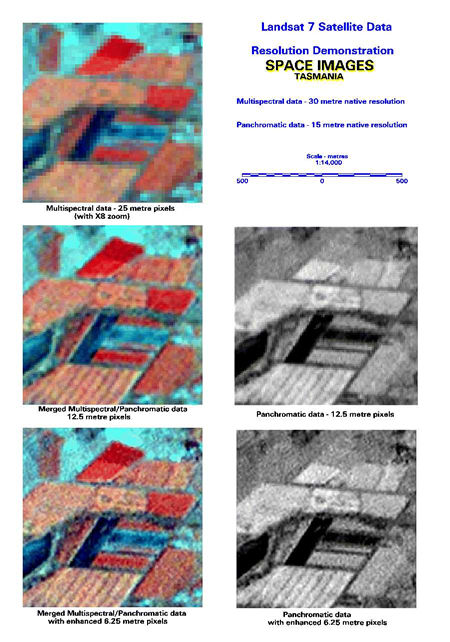
However, each sector of a CCD looks a certain area of the image which is focussed on it. The resultant picture, when magnified, will eventually show these as discrete pixels. Each pixel covers an area of land beneath, about 30m x 30m for Landsat.
Infrared detectors can vary in type from those whose resistance changes with warming ( thermal detectors ref1 , ref2, ref3 , ref4) to "photon type" detectors which use a direct photon-electron interactions very much like the CCD. These can require cooling using liquid nitrogen or helium. Landsat uses thermal detection and a scanner which is a mechanical mirror sweeping the image onto the detector.
The images below are at 50% real size.

