ESSENTIAL OILS IN TASMANIA [home] [topic page]
"Essential Oils" are the concentrated extracts from aromatic plants. They are used by the perfume, pharmaceutical, toiletry and food industries. ( Here "essential" is used in its original context derived from "essence" meaning "main or pure part, all that makes a thing what it is" - NOT in the more modern "absolutely needed" sense!! Note that "scent" is derived from the same origin.)
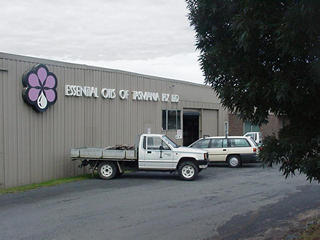
The company, Essential Oils of Tasmania Pty Ltd ( EOT ) started in 1986 and is now owned by the Bronson and Jacobs Group.
Some essential oil production was carried out before EOT was established. The Denny family developed lavender production for the international market in the 1920s at Bridestowe Estate near Lilydale. This continues today and is now part of EOT. Peppermint oil was produced in the Derwent and Huon Valleys in the 1970s. Hop production goes back over 100 years as an example of another essential oil.
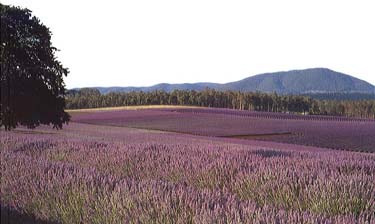
Tasmania is ideally suited to the production of of temperate essential oil crops because the latitude results in the right daylength and day/night temperature variation for the development of the secondary plant metabolites which accumulate in the plant as essential oils.
ESSENTIAL OILS contain many chemicals though some occur often. Many oils are alkenes - the TERPENES - of which there are a huge number.
Various techniques are available for the extraction of essential oils from herb materials, the most common being steam distillation and solvent extraction.
EOT uses steam distillation when producing peppermint, spearmint, fennel, parsley, caraway, dill and clary sage.
Solvent extraction is used for blackcurrant buds, brown boronia and native pepper.
In their most basic form, methods for recovering and concentrating essential oils originated hundreds of years ago and it is still possible to find industries using crude steam distillation systems in some Third World countries
Tasmanian Essential Oils located in Kingston to be near the University of Tasmania's analytical centres at the School of Agriculture and the Central Laboratories. It makes extensive use of the gas chromatographs, mass spectrometers and other equipment as well as the expertise resident at the University in soil sciences, plant growth and chemical knowledge of volatile molecules.
The company is experimenting presently with extraction from native plants which have many unknown chemicals. Here the best extraction techniques must be developed and the molecules analysed and tested.

