SPECTROMETRY [home] [topic page]
Spectrometry is the study and measurement of "light" from atoms and molecules. It relies on the use and understanding of quantum mechanical processes happening to atoms and molecules.
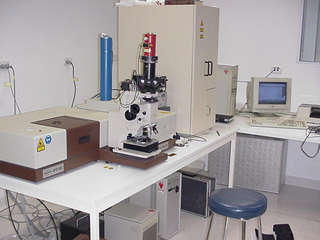
Central Science Laboratory's Infrared Spectrometer
Since the time of the "Bohr atom" of 1913, the atom has been understood to have certain mathematically permissible energy states or levels for its electrons. Transitions between these states lead to emission or absorption of packets of light called photons.
Each photon involved with the energy level changes have characteristic "colours" - wavelengths or frequencies - associated with them which allow identification of the atoms or molecules to take place.
The energy of these photons is related to the frequency by
E = hf h = Planck's Constant, f = frequency
Sodium atoms in one type of street light give of the characteristic "orange" light of sodium. Exactly the same colour can be seen by placing sodium chloride in a very hot flame - the sodium gives off the same colours! "Neon" lights give off a brilliant red which turns out to be a huge variety of reds and indeed yellows when viewed carefully separating the light up with a prism or diffraction grating.
Emission spectra are given when the atom is excited by heating or having electricity pass through under high PD. They release light as the electrons "relax" - revert to their lower energy states.
Absorption spectra are formed if the the light passes through a colder gaseous region of the atoms or molecules and the light is absorbed by the gas.
Spectrometry dates back to the mid nineteenth century when physicists and chemists such as Robert Bunsen and Balmer studied the effect of heat on various chemicals. They created early primitive spectroscopes, devices for looking at light. New elements such as helium were first discovered from the emission and absorption spectra of heated samples. Even the Sun shows clear emission and absorption spectra as observed by Fraunhofer.
Now, in the twenty-first century, the atoms and molecules are very well understood in terms of quantum mechanics, and we can, with the help of online computing, identify atoms and molecules with considerable ease simply by heating a sample or by subjecting the sample to suitable radiation.
Atomic Emission Spectrometry
This operates in the visible region of the spectrum. The energies involved are greater than for molecules hence the higher frequencies in the optical region.
These machines work by breaking down the molecules, using high temperatures to individual ionized atoms.
These ionized atoms then emit their characteristic frequencies. The combined output of light is split using a diffraction grating and detectors then measure the wavelengths present and brilliance of the light. This information gives both the elements present and the relative percentage compositions.
Infra Red Spectrometry.
Whole molecules, especially covalent molecular structures such as carbon based molecules, vibrate, rotate or spin and generally change shape in characteristic ways. The energies of these changes are again governed by quantum mechanics so certain particular energies are associated with different molecular structures.
The energies associated with these structures are much lower than those of atoms themselves as the electrons bonding the molecules are a long way from the nuclei of the atoms involved. This results in a spectrum far removed from the optical in the much lower energies of the infrared.
By illuminating the molecules with infrared light, the molecules will be "excited" by absorbing the relevant frequencies and producing a resultant absorption spectrum which clearly show such features as -OH, -COOH and other groups as present or otherwise.
An analyst can then turn around and, with certainty give the functional groups. It provides a quick reference. A full analysis can give the actual molecules present though this is difficult.
Further excellent sites on this topic include
http://www.wpi.edu/Academics/Depts/Chemistry/Courses/CH2670/infrared.html
http://www.wag.caltech.edu/home/jang/genchem/infrared.htm
